


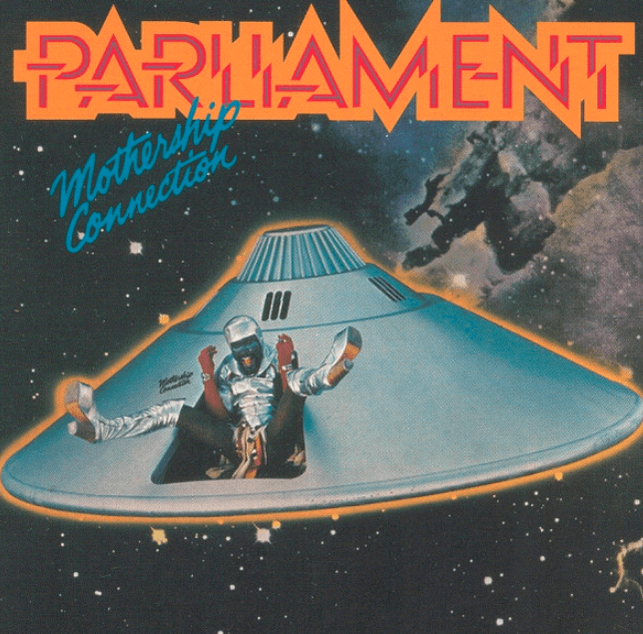
Parliament’s Mothership Connection turned 50 this week. To celebrate the album’s birthday, we look at the huge influence that Parliament-Funkadelic had on hip-hop.
Hip-hop producers like Dr. Dre built careers on Parliament-Funkadelic songs. Dre’s first album, The Chronic (1992), mined the 1975 classic Mothership Connection for Bernie Worrell’s space synths and hooks like “Slow down sweet chariot, stop, and let me ride” (‘Let Me Ride’), which itself was lifted from a African American spiritual. Dre’s use of the chorus from ‘Mothership Connection (Star Child)’ was one of the earliest prominent examples of such blatant inspiration.
Unlike many other producers, Dre recreated the parts in the studio. He also used ‘P-Funk (Wants To Get Funked Up)’ for ‘The Roach (The Chronic Outro)’, as well as Funkadelic and George Clinton tunes elsewhere on the album.
In the ’90s, when sampling gained attention in the mainstream media – and the courts – Clinton stood out among those being sampled for supporting hip-hop artists. He has continually championed the artistry of producers like Public Enemy’s The Bomb Squad. Clinton wrote in his fantastic memoir, Brothas Be, Yo Like George, Ain't That Funkin' Kinda Hard On You?:
“When I heard ‘Bring the Noise,’ I knew that they understood the way that sound could either organize upward into music or dissolve into chaos, and how both of them were parts of the same continuum. When you admit what you’re making is noise, you’re halfway there. They had the vocals and the sonics: they said it right off the bat, with ‘Bass, how low can you go?’ In P-Funk, we were always tuning our guitars down or setting up Bernie’s synthesizers to get the deepest vibrations possible.”
‘Bring the Noise’ samples the guitar feedback from Funkadelic’s ‘Get Off Your Ass and Jam’.
When music publisher Armen Boladian tried to sue Public Enemy for using Parliament’s ‘Body Language’, Clinton appeared on MTV to say he had no problem with the sample.
In fact, Clinton was so inspired by The Bomb Squad’s sampling that he “started to do [his] own version of the same thing, sampling older P-Funk records” for the album Dope Dogs (1994). He produced the album “in the most labor-intensive way possible”, taking a three- or four-second loop, running it throughout the song, then muting parts of the loop he didn’t want. Clinton then brought in musicians like Blackbyrd McKnight and Bernie Worrell to play guitar and organ over the loops.
Clinton was inspired by rappers, not just their producers. He often cites Rakim as a favourite. On songs like ‘U.S. Custom Coast Guard Dope Dog’, Clinton raps himself. Check out his performance on Def Poetry Jam for a closer sniff at the words.
In previous years, Chuck D and Flavor Flav had appeared on Clinton’s albums The Cinderella Theory (1989) and Hey Man, Smell My Finger (1993). The latter also featured rappers whose music sampled P-Funk far more explicitly: Shock G of Digital Underground, Dre, Ice Cube.
Cube’s ‘Bop Gun (One Nation)’ actually features Clinton. The song interpolates several P-Funk tunes: ‘Star Child’, ‘Handcuffs’, ‘Dr. Funkenstein’, ‘Do That Stuff’, ‘Flash Light’, ‘Sir Nose D'Voidoffunk (Pay Attention - B3M)’, ‘One Nation Under a Groove’, ‘Atomic Dog’, and ‘Loopzilla’.
We’ll revisit P-Funk’s influence on hip-hop later in this series. If you need another trip on the Mothership in the meantime, read an album retrospective by The Afterword.
Top image from Discogs.