


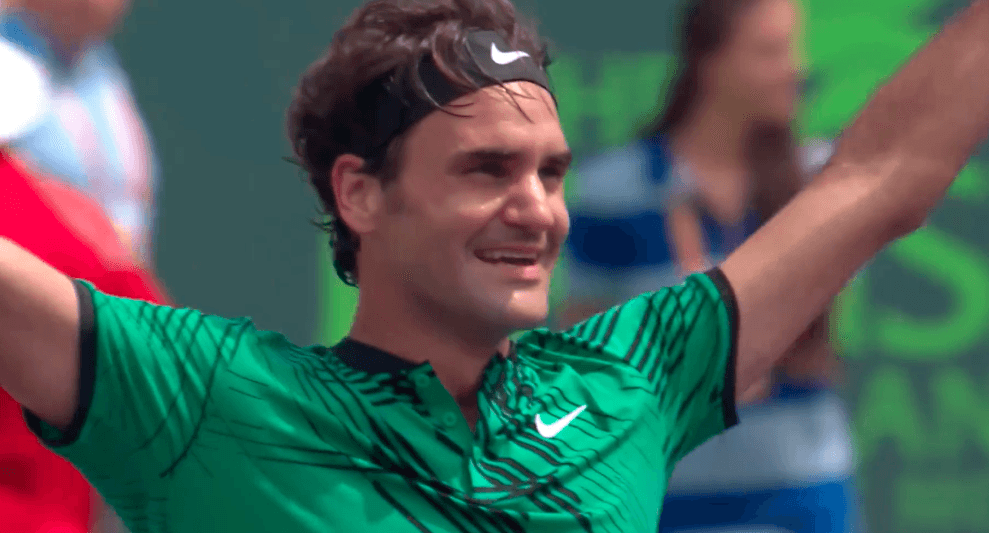
Roger Federer had an extraordinary start to 2016, winning the Australian Open, beating his great rival Rafa Nadal in the final in one of their all-time classics, then winning the Sunshine Double: Indian Wells and Miami.
This year’s Miami Masters has had surprising results, arguably making a mockery of questions about a possible new Big Four. Jack Draper lost to Reilly Opelka, who hit 25 aces in two tiebreak sets. Daniil Medvedev was bagled by Francisco Cerundolo in a three-set loss, and double-faulted on match point. That said, world No 1 Carlos Alcaraz himself lost to Sebastian Korda, the lowest ranked player to beat him in a year.
Arthur Fils, only 21 and another potential challenger to the Big Two in the coming years, had “the best result I've had in my life so far”, beating Tommy Paul in the quarters and reaching his first Masters semi-final.
Sinner is in the semi-finals after beating Frances Tiafoe 6-2, 6-2. The latter didn’t even play badly. Sinner will close the gap to Alcaraz to 1,240 points if he takes the title, and would be the first player to win a Sunshine Double in a single year since Federer. But no matter well Sinner’s playing, he’s unlikely to stun crowds in the quite the same way as Federer did seven years ago.
Federer’s Sunshine Double in 2017
In the first few months of 2017, Federer played some of the most remarkable attacking tennis ever. He had missed most of the 2016 season, largely due to a knee injury and surgery. Federer started 2017 as the world No 17, his lowest ranking in over 15 years. Pundits wondered if he’d ever win a Slam again. In Australia, the 35-year-old Federer became the oldest man to compete in a Slam final since Ken Rosewall in 1974. He beat Nadal 6-4, 3-6, 6-1, 3-6, 6-3 in a match to rival their 2008 Wimbledon classic.
Australian Open
After a disappointing 2013, Federer began making changes. He switched to a larger racket frame, hired his idol Stefan Edberg as coach in 2014 and then Ivan Ljubicic in 2016, and started hitting backhands more freely.
Nadal’s lefty serve and topspin forehand, constant chinks in Federer’s armour since their first meeting in 2004, were now less troubling.
[1:40] In the first set, Federer takes a wide serve early on the backhand, hangs in a long rally with a forehand squash shot, then gets on the front foot with a deep, attacking backhand, and finishes the point off with a swinging volley.
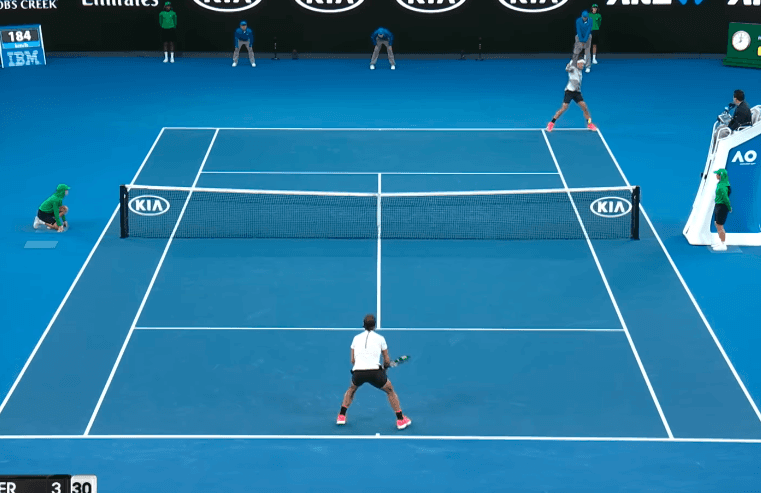
[8:25] At the start of the third set, Nadal hits three groundstrokes that land a hair off the baseline in a single point, but Federer refuses to back up. He defends with a sweetly-timed half-volleyed backhand, and then hits an attacking one tight crosscourt that even Nadal can’t retrieve (below).
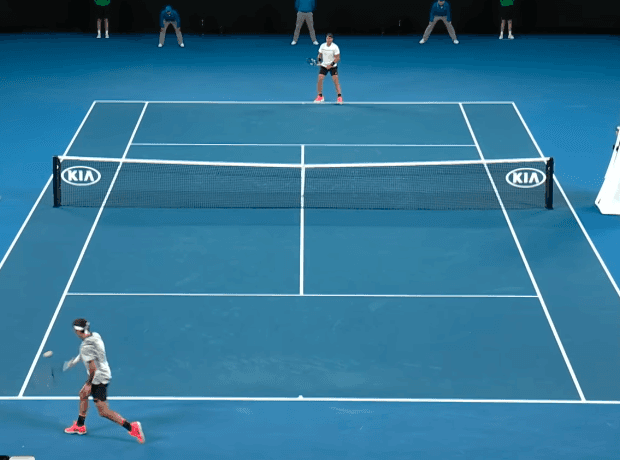
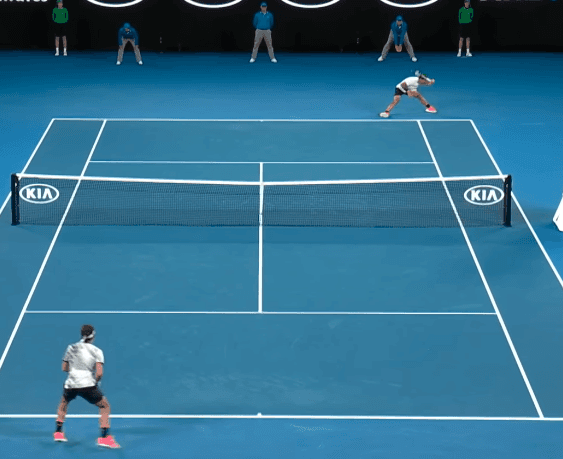
But Federer’s most remarkable tennis was when he took charge of rallies before Nadal had a chance. To go 5-1 up in the third (11:43), Federer takes another ad-side serve inside the baseline (below). Federer said later in the year, “I think by coming over my backhand [rather than slicing] on the return from the get-go in the point, I can then start dominating points from the start.”
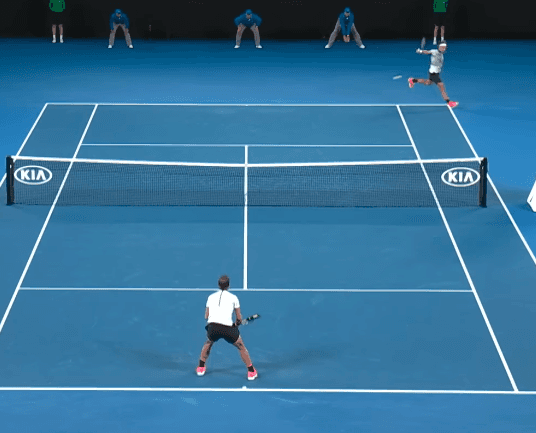
Then to save a break point (11:54), he only takes one step back to deal with Nadal’s floaty return, meeting the ball on the rise. Federer takes control of the rally and finishes it with an inside-out forehand off a ball that crosses his body, sending Nadal scrambling across the other side. Federer hits the ball with his feet off the ground, letting his arm swing freely (below).
Indian Wells
Two months later in Indian Wells, Federer continued the front-foot backhands. Due to their seedings (Federer 9th and Nadal 5th) after Federer’s time off, they met earlier than normal, in the fourth round.
In an unusually one-sided match (6-2, 6-3), Federer gets his second break (3:10) by hitting a clean winner down the line on the return.
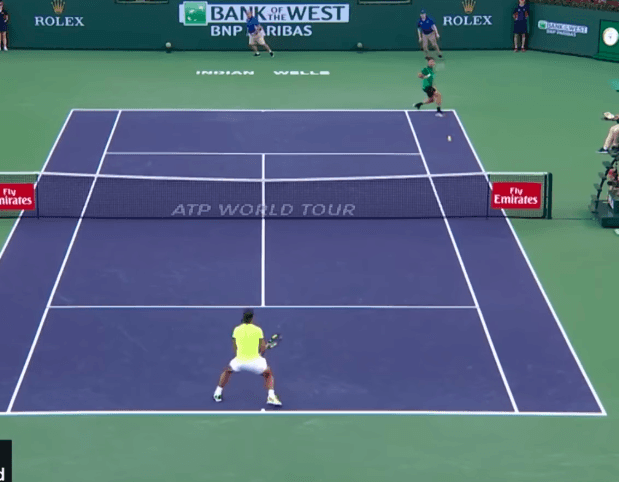
In that interview where Federer mentioned hitting more topspin returns, he sounded impressed by his own play: “Look at that. On the break point,” he said of that winner against Nadal. “I’m very pleased. Jeez.” Federer said the bigger sweet spot made backhands easier.
He was encouraged by his father: “Hit the backhand, damn it! Don't just fall back and slice all the time”.
In the second set (3:47), Nadal hits a body serve. Instead of slicing or blocking the ball back like he would in the past, Federer hits through the ball even though it’s directed straight at him. Like all the greats, he knew the court dimensions so well. So many of his shots landed just inside the lines. Nadal’s on the defence after a good serve and can only play a looping trading shot crosscourt. Still, there’s a lot for Federer to do, especially if he wants to finish it quickly. He does. He takes his father’s advice, and hits the damn thing. Look (below) how free Federer’s arm is after he’s stepped way inside the court and met the ball on the rise. It’s an absurd shot at shoulder height with a single-handed backhand off a topspin ball.
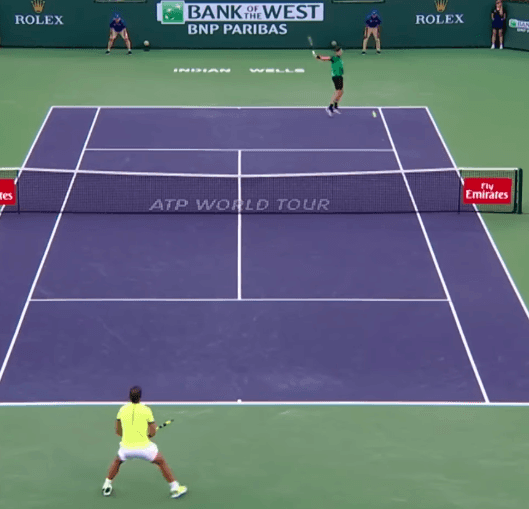
In the last game (4:04), Federer refuses to let Nadal breathe, hitting two backhands (below) and two forehands (the last a volley) to make one of the greatest players of all time look sluggish.
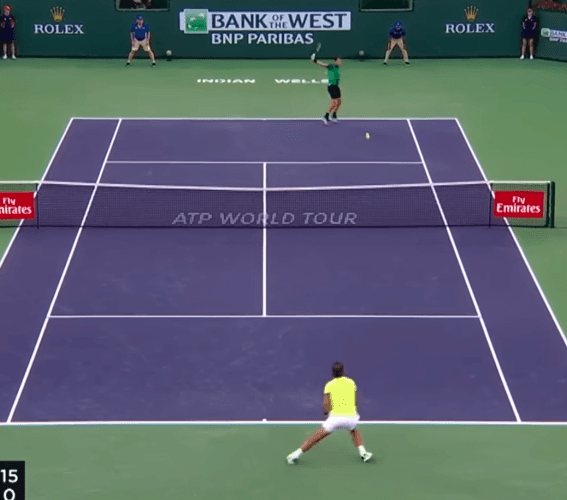
In the semi-finals against Jack Sock (6:08), Federer takes a return near shoulder height for another clean winner (below).
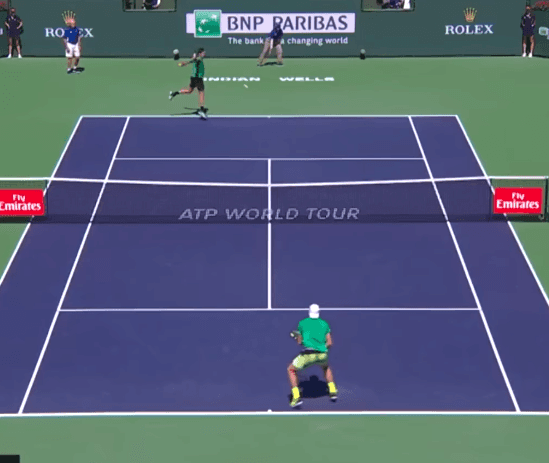
A lot of the attention that year was on Federer’s backhand, but his forehand wasn’t exactly bad. Of course, that shot had been admired for years. In the second set against Sock (6:35), Federer’s more than a metre behind the baseline after a heavy shot from Sock. Instead of going on the defence, he finds an extreme angle that pushes Sock way out wide (below), setting up a finishing forehand that Federer lands on the baseline for good measure.
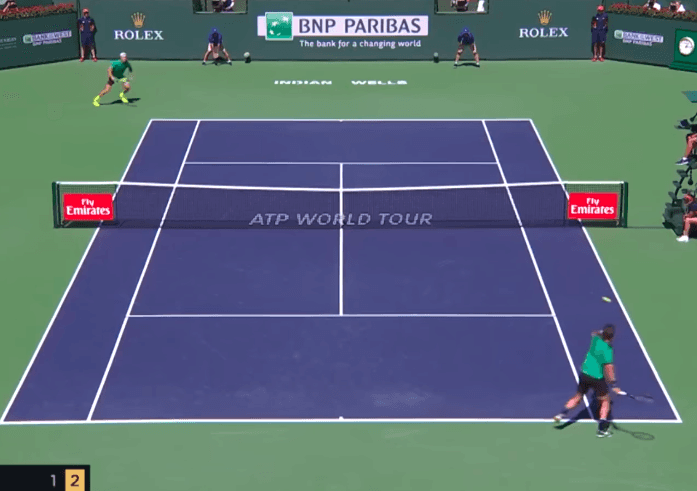
Down a break in second set of the final against Stan Wawrinka, Federer still looks relaxed. He hits a serve with some kick, then after a couple of shots hits a forehand half-volley off his feet, follows it in and plays a delightful drop volley, cutting across the ball to send it spinning away from Stan.
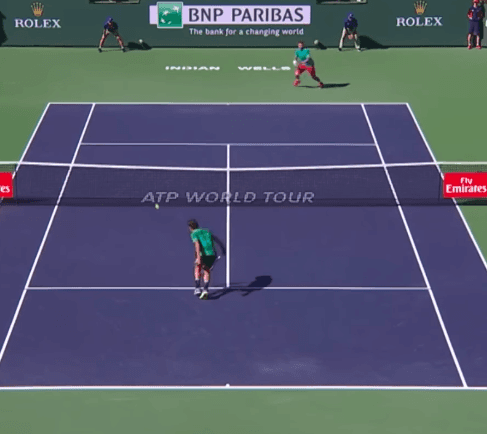
Federer attacked when he was down and attacked when he was up. On match point (8:57), he takes Wawrinka’s big kick serve on the rise. Federer refuses to give up too much ground when Wawrinka then plays a topspin backhand, again taking his own backhand early, finding a brilliant angle to push his fellow Swiss way out of position (below).
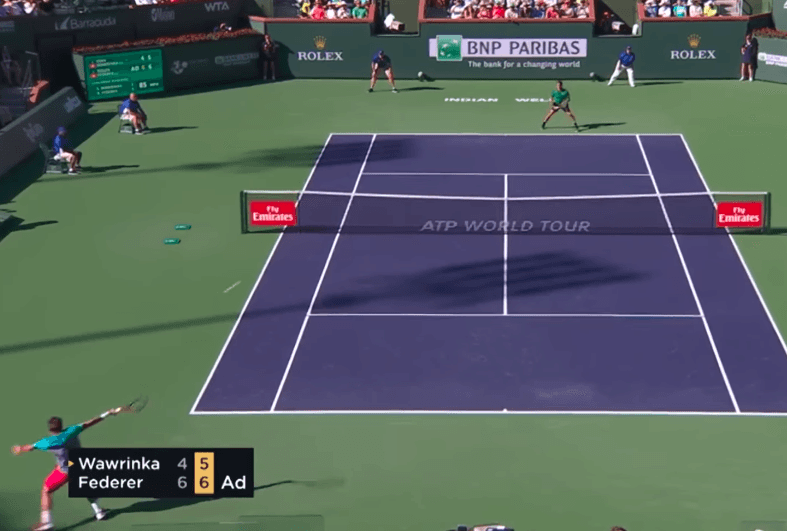
Federer then takes charge with an inside-in forehand, setting up a put-away volley.
Miami
And Federer’s tennis kept getting better. In Miami, he beat Nick Kyrgios (who was playing some of the best tennis of his career) in the semi-finals, and then Nadal in the final.
Against Tomáš Berdych in the quarter-finals (3:05), Federer plays one of the most famous drop shots in recent memory. An aggressive return, this time on the forehand, puts Berdych on the back foot and the Czech can only hit a central, short ball. Federer gives his drop shot loads of air. It’s such an unusual shot that Berdych’s rooted to the ground.
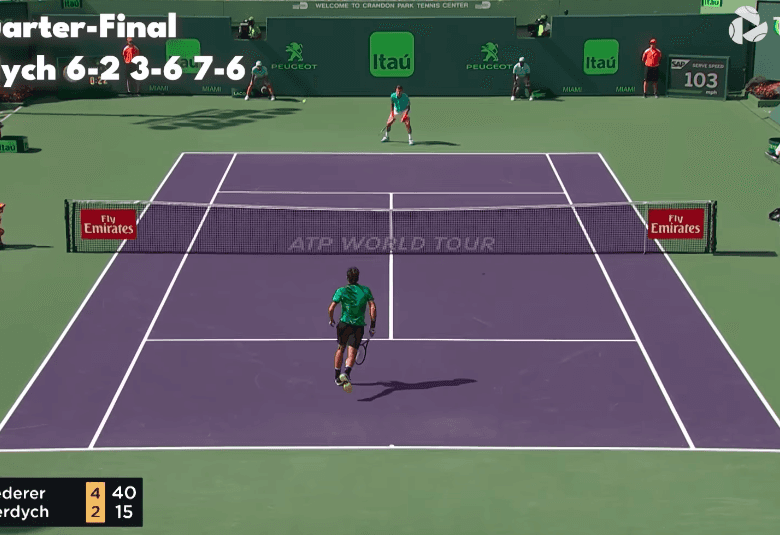
Federer saves a match point (4:15) by taking another backhand return (below) inside the baseline and rushing Berdych.
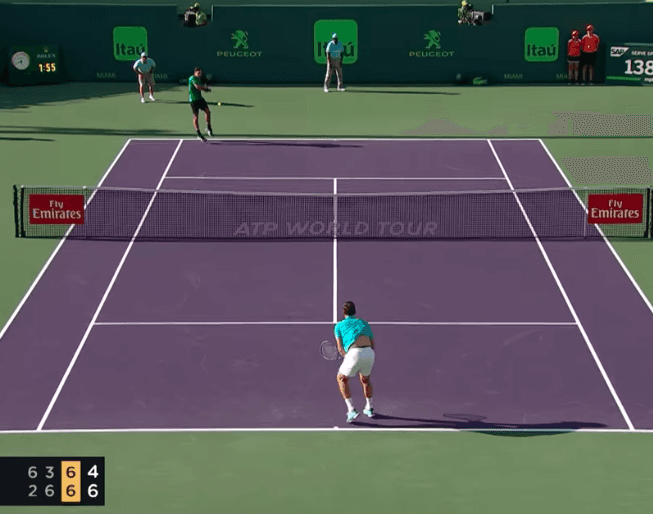
The Kyrgios vs Federer match was perhaps one of the finest three-setters in tennis history. They both played brilliantly.
In the first set tiebreak (5:05), Federer showed how quickly he could turn defence into attack. Kyrgios serves down the T and Federer has to really stretch to block the ball back (below). He then skips around the backhand (watch how fast his feet move) to hit an inside-out forehand (below) and gets Kyrgios scrambling despite having just hit a 136 mph serve. Federer finishes off with a swing volley, not giving Kyrgios time to reset the point.
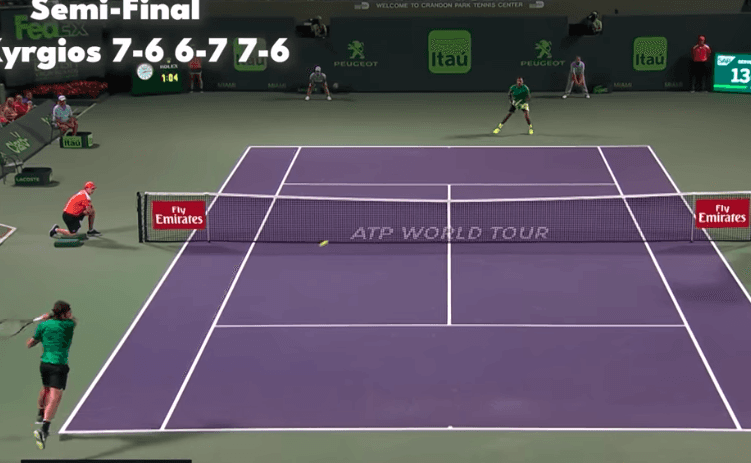
To go 6-5 up in the third, Federer played a serve and drop shot combination (7:07) (now a favourite play of Alcaraz, albeit on the forehand side).
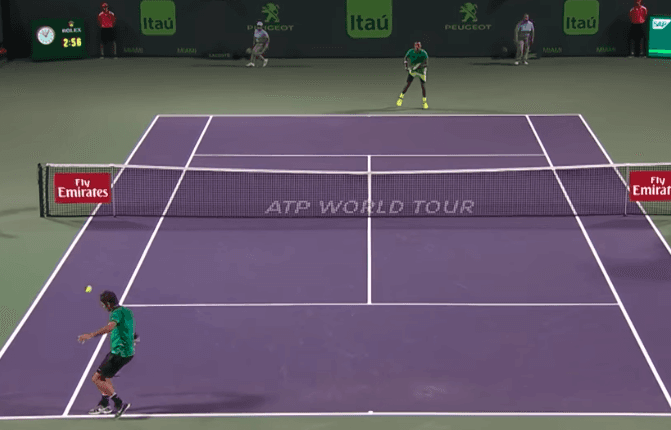
In that set’s tiebreak (every set went to a tiebreak), Federer dealt with an aggressive return and then approach from Kyrgios with another sweetly-timed half-volleyed backhand (7:39).
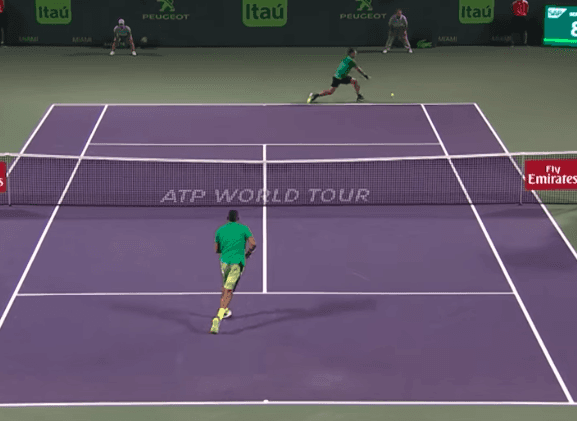
It was one of Federer’s bigger celebrations after winning the match. He didn’t particularly like Kyrgios.
After the wins in Australia and India Wells, Federer beat Nadal again in the Miami final. The full final is available on YouTube.
Nadal had historically served largely to Federer’s backhand. In 2014 that began to change, and by Miami in 2017 the picture was drastically different, with Nadal aware of Federer’s attacking power on that side. As Manas Sharma wrote, “At the Miami Open final this year, [Nadal] served almost equally to both sides, for the first time.”
Whether he served to Federer’s forehand or backhand (9:09), Nadal was often on the defence.
The Spaniard said after the match, “I think [Federer’s is] one of the best comebacks ever on the [ATP] Tour after a long injury, so well done.”
Top image from Tennis TV.