


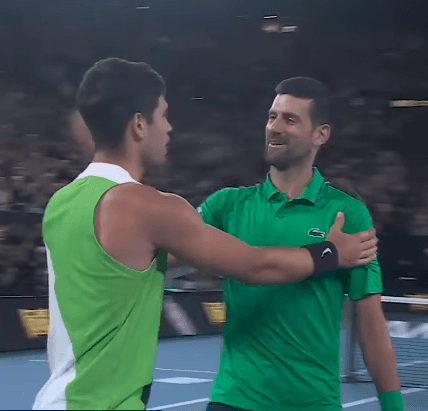
On Sunday, Carlos Alcaraz joined tennis greats like John McEnroe and Mats Wilander on seven Grand Slams.
Novak Djokovic had hoped to win his 25th to break free of Margaret Court’s joint record. But after the 38 year old broke twice in the first set, Alcaraz won the Australian Open men's final 2-6, 6-2, 6-3, 7-5.
At the end of the night, the pair’s sixteen-year age gap was evident. Djokovic made a gracious speech and then looked like he wanted to go to bed. Alcaraz looked like he could play for another few hours.
Strengths and limitations
The age gap was also evident in their tennis, of course. In the semi-finals, Djokovic had beaten world No.2 Jannik Sinner. The four hour match and 1:33am finish meant that Djokovic had less than 48 hours to recover before the final.
There was one game in the third set that summed up Djokovic’s late era qualities, as well as his limitations. At 3-5, 40-40 on Djokovic’s serve, Alcaraz hit one of many drop shots. It wasn’t his most well disguised, but Djokovic didn’t even try to run for it.
But then an unreturned serve got him back to deuce. The following point, an aggressive crosscourt forehand – the type he beat Alcaraz with at the 2024 Olympics – earned him a game point. But on that point, Alcaraz hit a wide shot to Djokovic’s forehand and he was a touch late getting there; knowing he didn’t want to hang around in the rally, he missed an ambitious down the line finisher.
Eventually, after a fourth deuce, two more errors from Djokovic gave Alcaraz the game and set.
History
In what turned out to be the last set, Djokovic was serving at 0-1. He missed a backhand at 40-40 and puffed out his cheeks as if to suggest it would be a long road to victory, two sets to one down against a player some have called the greatest young player tennis has seen. Alcaraz stood tall, ready for the next point like a boxer at a weigh-in, his vest showing off the extra muscle he’d put on in the off-season, and nodded to his team like everything was under control.
Djokovic held serve and made a fight of the last set, but couldn’t stop Alcaraz from becoming the youngest player to complete the career Grand Slam (winning all four majors: Australian Open, Roland Garros, Wimbledon, and US Open).
Djokovic did make some history, though: he overtook Roger Federer for the most Australian Open wins in history (104 to Federer’s 102) and became the first ever player to win 400 Grand Slam matches.
With the first Slam of the year wrapped up, here are seven of Alcaraz’s finest rallies in Australia in honour of his seventh major.
Drop volley v Adam Walton
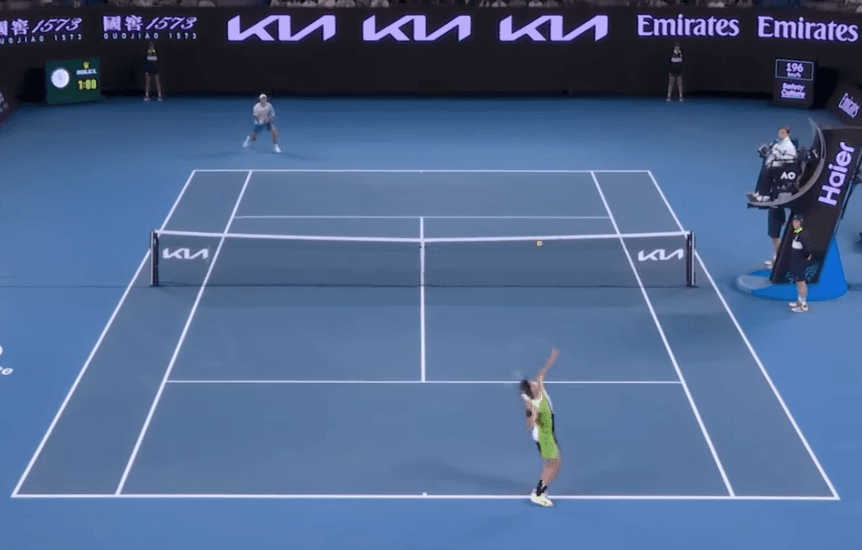
In his first round match, Alcaraz shows off his new service motion. As Nick Nemeroff highlighted, Alcaraz has modelled his serve on Djokovic’s. One major difference is that Alcaraz hits with his feet together (pinpoint stance, as seen above) and Djokovic hits with a platform stance. Alcaraz won two Slams in 2025, losing only three service games during the entire US Open. But he wasn’t content. He knew he could improve his serve. As Nemeroff writes:
Alcaraz is modeling Djokovic’s cobra position, where the hitting wrist gets into a curled or flexed position as the ball is released. The toss is up and the tip of the racket is down.
(...)
The benefit of the curled cobra position, besides relaxation and fluidity, is that it facilitates a more closed racket face through the swing and a cleaner throwing motion. The wrist being curled makes it less likely for a player to open the palm and the racket face.
(1:30) In the second set against Adam Walton, hits a decent body serve. Walton does well to move out the way and hit a backhand to Alcaraz’s backhand. But it’s not deep enough and Alcaraz is on the front foot: he hits a crosscourt approach. It’s far from his best, and he was too deep to come in. Walton hits an awkward ball towards Alcaraz’s feet, but then the magic happens.
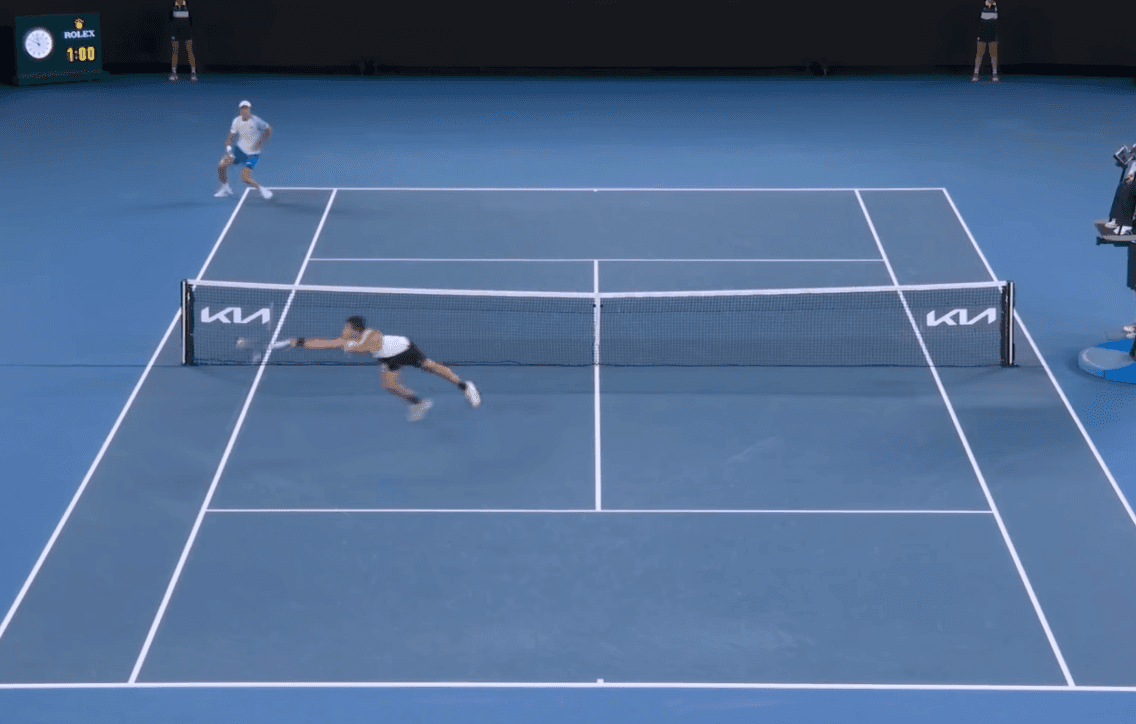
Alcaraz times the half-volley brilliantly and despite Walton hitting a passing shot a good five feet to his left, Alcaraz somehow maintains his balance to hit an unplayable drop volley winner.
Forehand winner v Yannick Hanfmann
(4:25) In the second round, Yannick Hanfmann experienced the hopelessness of neutral balls down the middle of the court against Alcaraz. A few balls into a rally, Hanfmann lacks intent on a forehand and slightly mistimes his swing, giving Alcaraz time to skip around his backhand.
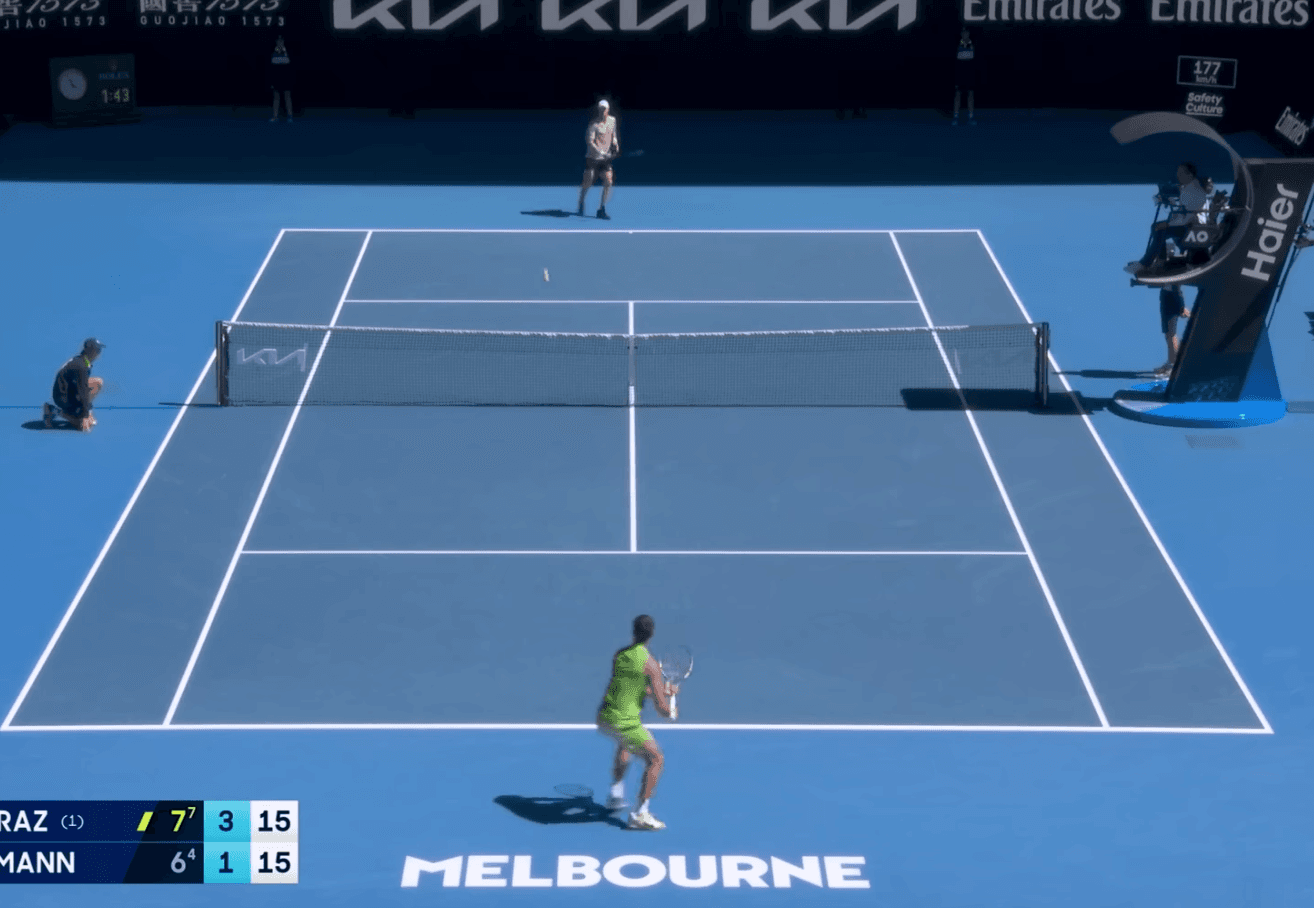
From this position, almost every player in the world is finished. Hanfmann has to guess: he makes a slight move to his left and Alcaraz’s forehand is past him before anyone has a chance to blink.
Lob and drop shot v Corentin Moutet
In a straight sets victory for Alcaraz, in the third round Corentin Moutet delivers as many spectacular moments as the champion (see the point at 6:55).
Moutet can sometimes match Alcaraz’s drop shots. But the latter’s thunderous groundstrokes, stronger serve and greater athletic ability make the difference. At 4-1, 15-15 in the first set (1:20), Alcaraz shows everything off in one rally.
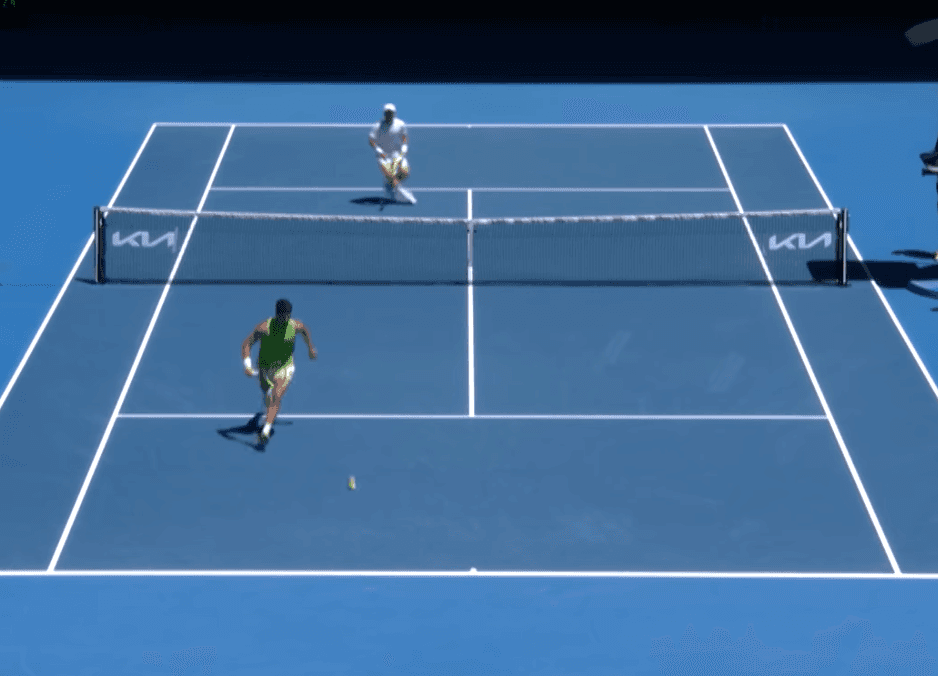
Just when Moutet might think he’s up in the rally after hitting a lob, Alcaraz hits an even better one of his own. He then measures a drop shot even more perfectly, forcing Moutet to run into the shadow and then back up to the net. Alcaraz would likely get there in plenty of time. Moutet doesn’t, and barely anybody else would.
Serve and drop shot v Tommy Paul
(6:55) In the fourth round, Alcaraz serves at 4-4, 40-0 in the third set. Perhaps feeling like he has to try something different to break, Paul steps back deep during Alcaraz’s service motion. But that’s a bold, and most often fruitless, move. Has anyone in the history of tennis played the serve and drop shot combination better? Paul is so far back the drop shot doesn’t even need to be that good, but it is. All Paul can do is chip a ball up into the middle of the court; Alcaraz is there to put away an easy volley.
Attacking v Alex de Minaur
6th seed Alex de Minaur can’t get a set off the champion in the quarters as he speeds to a fifth successive straight sets win. In the third set (6:38), the difference between the pair’s groundstrokes and intent is striking. Alcaraz always seems to be on the attack – even when he’s stretching against players like Djokovic and Sinner – while de Minaur often seems to be struggling. Alcaraz hits with tons of spin, giving him margin over the net and safety inside the baseline. De Minaur hits flat, and sometimes lacks the spin and speed to attack or trouble players when they approach the net.
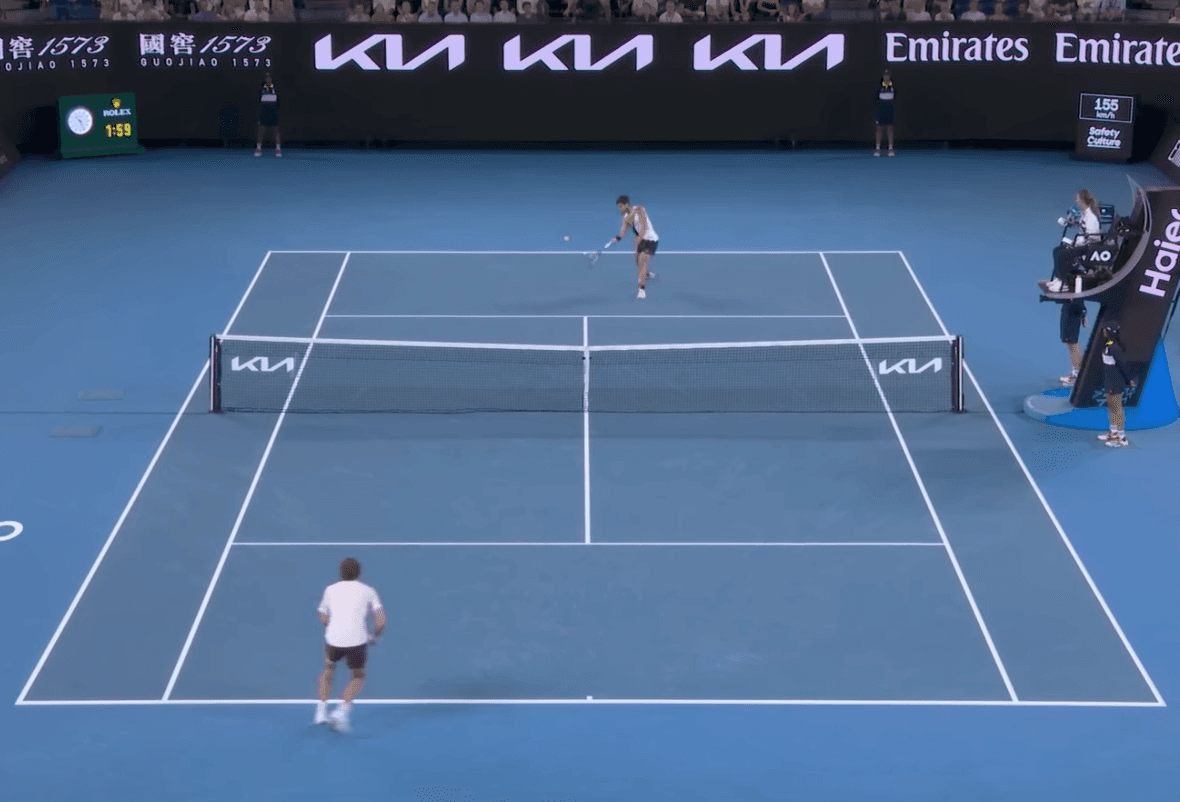
He hits a floaty backhand with Alcaraz able to volley above the net despite being around the service line. Then the lack of front foot intent seems to affect de Minaur – instead of attacking the ball, he backpedals, giving Alcaraz the chance to close the net and hit a good finishing volley. That’s a harsh critique of de Minaur – he’s the sixth best player in the world – but against Alcaraz, almost everyone looks a world apart.
Running passing shot v Alexander Zverev
Alexander Zverev pushes Alcaraz closer than anyone else, stretching the semi-final to five sets, five hours and 27 minutes. In the deciding set (6:02), Zverev plays a great point: 198 km/h serve close to the tee, big approach shot to the backhand, and a well-measured stop volley in the opposite direction. But it’s not good enough. Alcaraz has slidden into the backhand, maintained his balance, and is well on his way towards the ball before Zverev has made contact on the volley. Alcaraz charges forward, sliding again, just in case there’s any way Zverev can reach the ball and he has to change direction once more. But there’s no way: Alcaraz’s passing shot is too good and Zverev likely wonders what on earth he has to do to close out the match.
Backhand winner v Djokovic
(1:52) In the final, Djokovic hits an excellent wide serve from the deuce court. Alcaraz has to stretch way outside the doubles line to make the return.
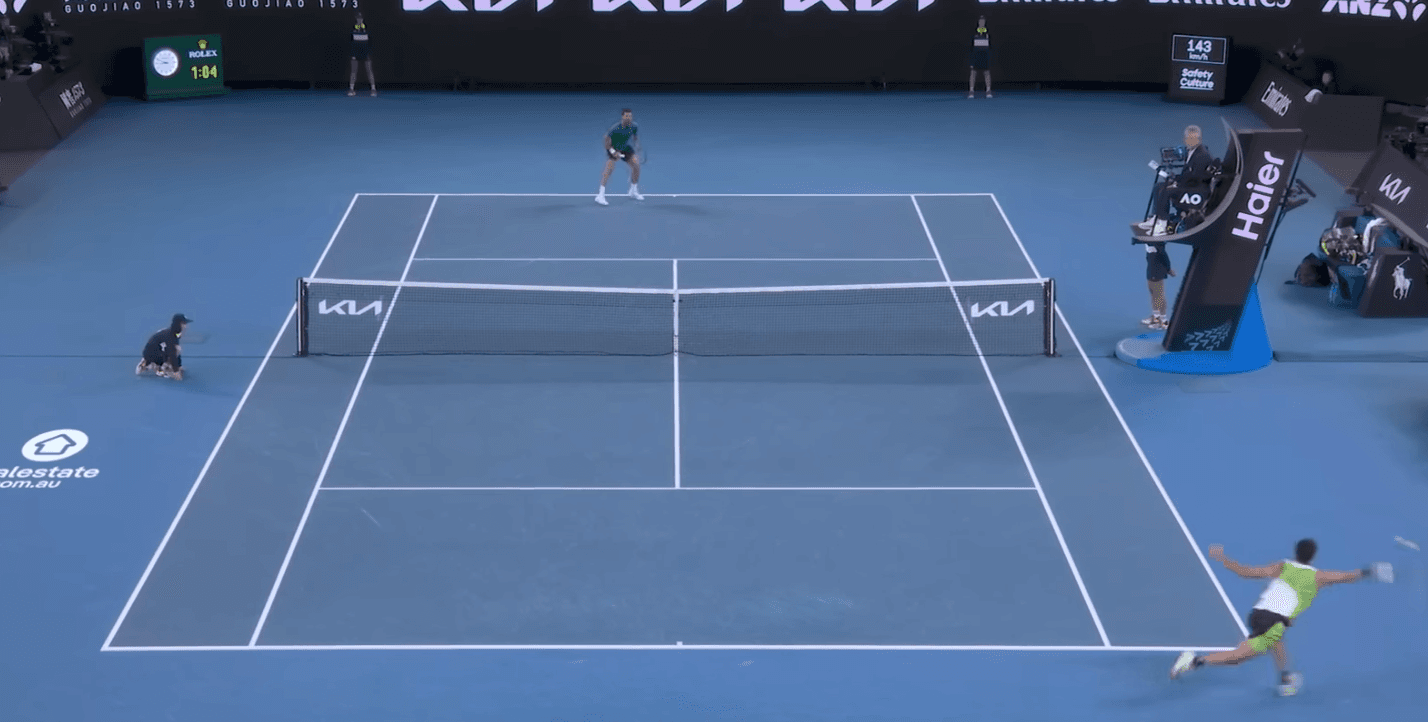
From this position, Djokovic would likely be confident of winning the point against anybody but Sinner and Alcaraz. Djokovic hits a backhand into the open court, and Alcaraz is there in plenty of time. He hits a sliding, open-stance backhand winner – the type of shot Djokovic made famous.
Djokovic last won a major at the US Open in 2023. The 38 year old isn’t quite ready to let tennis have a Big Two – and still looks the likeliest to beat them – but since Djokovic’s 24th Slam, Alcaraz and Sinner have shared the last nine.
Top image from Australian Open YouTube channel.