


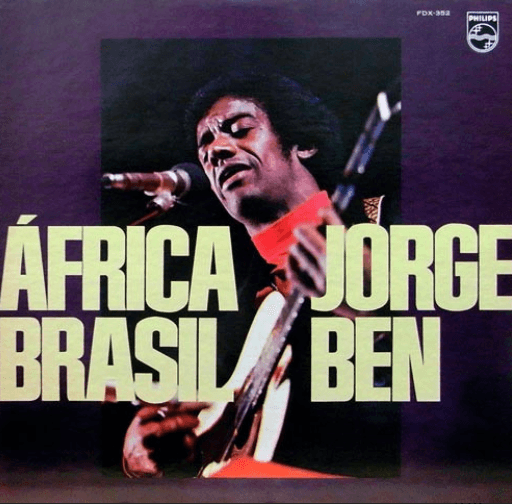
January is Jorge Ben Month on Edge of the Line. We’re celebrating 50 years of África Brasil.
After its opening 15 seconds, Jorge Ben’s ‘África Brasil (Zumbi)’ is anxious energy without a resolve for its near-four minutes. ‘Zumbi’ originally appeared on A Tábua De Esmeralda (1974) as the sort of song on which Jorge built his career – so beautiful you can picture floating away on the sun without burning. If you don’t speak Portuguese, it’s a picture-book beach day, unhurried and undisturbed.
Despite the original’s beauty, its lyrics were about slavery. However, ‘Zumbi’ refers to Zumbi dos Palmares, who helped resist enslavement of Africans during colonial Brazil, and the song ends on a hopeful note: “Eu quero ver Benguela / Quando Zumbi chegar / Monjolo / O que vai acontecer? / Cabinda / Eu quero ver Mina / Quando Zumbi chegar” (I want to see Benguela / When Zumbi arrives / Monjolo / What will happen? / Cabinda / I want to see Mina / When Zumbi arrives”. Jorge has listed ethnic designations used by the Portuguese colonisers earlier in the song – Benguela and Monjolo among them – and Mina refers to Castelo de São Jorge da Mina, where slaves were sold in Ghana.
Jorge transformed the song for África Brasil. The lyrics are essentially the same but rearranged, with the “Eu quero ver o que vai acontecer quando Zumbi chegar” (“I want to see what will happen with Zumbi arrives”) coming early, matching the music’s impatience.
Neném’s cuíca sounds deranged, rather than simply restless as it does on much of the album, when paired with paired with a foreboding bassline and marching percussion. From 2:23, with the guitar and bass dropping out, the cuíca sounds even madder and proceeds to play a bizarre flurry of notes from 2:30.
Aside from the lyrics, the songs could hardly be further apart. They’re in different keys and tempos, and the instrumentation is completely different. Even with the lyrics, the vocals are not very similar. Jorge’s voice is strained on the updated version, with an urgency that was unimaginable on the original. On the original, “Zumbi é senhor das guerras / Senhor das demandas” (“Zumbi is the lord of war / The lord of demands”) sounds hopeful – grateful perhaps. On the updated version, those lines sound threatening. Jorge barks them like a rallying cry to soldiers.
Amid the strained vocals, the cuíca’s squeals, and the overall sense of unease, the One offers brief moments of grounding. The bass, guitar, and percussion all hit that beat. Thanks to the One, you know where you are; you know you’re going forward as the band relentlessly sweeps you away. The closest we get to a resolve is the saxophones coming in at 2:50, with their melody briefly sounding celebratory.
While the chord progressions are different, the opening of Outkast’s megahit ‘Ms. Jackson’ sounds somewhat inspired by that of ‘África Brasil (Zumbi)’. It’s probably pure coincidence: Andre 3000 has never mentioned Jorge Ben, and he’s not shy about crediting his influences. Neither has Big Boi or David Sheats (known as Mr. DJ), the other co-writers and producers.
Kamille Viola, author of África Brasil: Um dia Jorge Ben, has described Ben’s social commentary as revolutionary. Jorge was paying homage to black culture in a deeply racist country. Viola said she was watching Hip-Hop Evolution, a documentary series, which reported that Grandmaster Flash & The Furious Five’s ‘The Message’ was the first rap with social criticism. ‘The Message’ was released in 1982. Jorge was way ahead.
Top image from Discogs.