


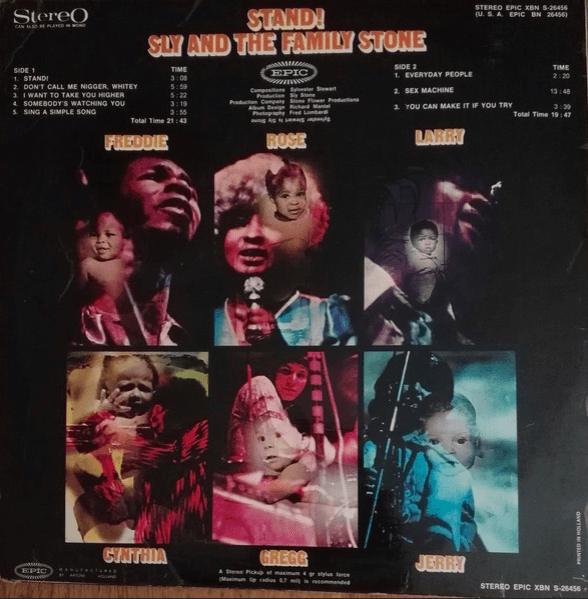
This month is Sly September here on Edge of the Line, in honour of 2026 marking 60 years since the formation of Sly and the Family Stone.
Sly and the Family Stone’s ‘Sing a Simple Song’ has been sampled by hundreds of artists. And long before sampling was a thing, it was covered three times in 1969, the year of Stand’s release: versions were recorded by The Meters, Booker T. & the M.G.'s, and Diana Ross & The Supremes and The Temptations on the Tamla Motown LP, Together.
Rap producers loved the drum break in ‘Sing’ (2:10). Drummer Greg Errico was an always groovy, tasteful drummer. He could have played more fills to add more pizzazz to that bridge, but he played what felt good – and continued to feel good to artists sampling him for over 40 years.
Errico appreciated rap. He told Red Bull Music Academy that he’d have liked to have been “financially rewarded” for all those samples, but was glad to have been part of the “new world”, and he understood the art form:
“Rap is rhythm and rhyme. It’s a drum beat, a groove and poetry. That’s what rap is. Very few artists, back in the day, did that. Rhythm is fundamental in the universe, and in communication as music. There’s no language that speaks to everybody, all cultures, like rhythm.”
Del The Funky Homosapien’s ‘Worldwide’ is typical of the records that sampled the Family Stone – that is to say, it’s funky.
It’s also an example of Errico’s neat assessment of rap. There’s not an awful lot going on other than the ‘Simple’ sample and Del’s rhymes. His voice and constantly changing intonation add personality to a barebones song.
While Del sometimes emphasises predictable syllables (“HATE ya”), his rapping is a bit like the drum break in that you might expect the emphasis, but it sure feels good. The second verse is rapped by Unicron (“this kid is dope”, Del says), with the junior rapper’s higher pitch an interesting contrast.
(Del later lent his unmistakable voice and flows to Gorillaz for their first big hit, ‘Clint Eastwood’, with his larger than life character serving as inspiration for that fantastic video.)
‘Sing a Simple Song’ was a Friday Funk topic last year; in that article, we discussed Sly’s arrangement. The bridge starts with only Errico’s drums and Jerry Martini’s saxophone. The drums sound fantastic. Errico was wholly complimentary of Sly’s arranging skills, as well as his engineering and production decisions. Sly helped shift drums to the forefront of popular music. As Errico said:
“Sly loved rhythm, he was inspired by it, so he mixed the drums in front of the record. That was the predominant sound and everything else went on top of that.”
This was decades before rap and dance music had taken over the charts. In 1969, songs like Tom Jones’s ‘I’ll Never Fall in Love Again’ and The Foundations ‘Build Me Up Buttercup’ made the Billboard Top Hot 100.
Sly mixing the drums at the front, and giving space to each musician in his arrangements, meant that rap producers had a deeply funky sample at their fingertips.
When ’80s artists like De La Soul and Digital Underground wanted to rap to Errico’s beat, Prince Paul, Shock G and contemporary producers couldn’t use AI to isolate drum stems. Songs like ‘Sing a Simple Song’ gave them a simple way of producing a funky song.
Top image from Discogs.