


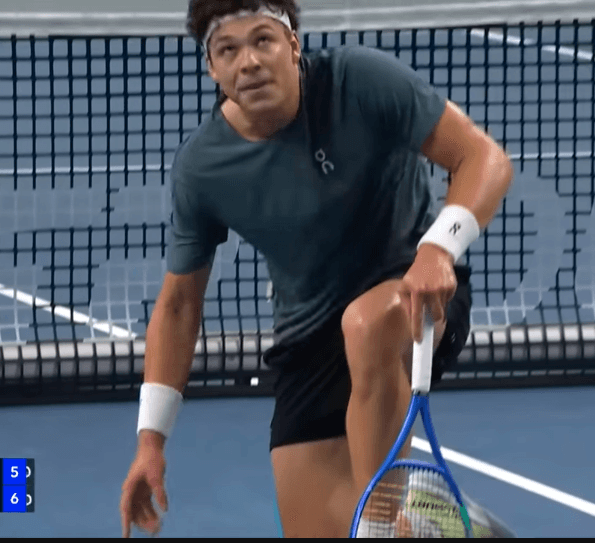
The top two seeds at the Dallas Open made Sunday’s final. Taylor Fritz and Ben Shelton are USA’s No 1 and 2 and both ranked in the world top 10. Almost 5000 miles and seven hours away in Rotterdam, Alex de Minaur had competed in another ATP 500 final. Shelton and de Minaur won their first titles of 2026 with hugely contrasting approaches.
After the first seven games in Dallas were mostly a breeze for Fritz, Shelton seemed to make him think a bit more when serving for the set at 5-3. Shelton backed up on second serves, got into more rallies, and put the pressure on. But Fritz kept his head after a couple of mistakes and held serve to take the set without losing a point on his first serve.
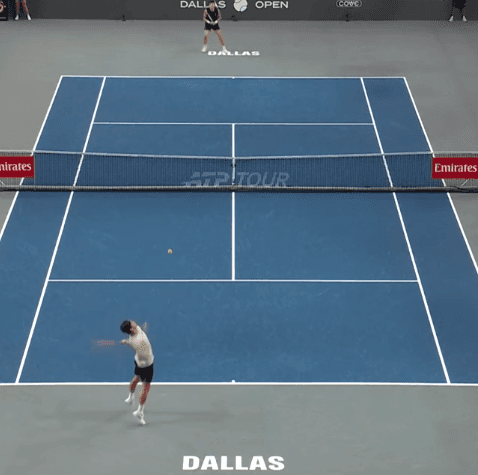
Far from a servebot, Fritz played two outstanding points at 2-2, 30-0 and 30-15 in the second set. The first (2:55) finished with a jumping smash near the baseline and the second a swing volley after an extended rally. Shelton did well to close out that game. He likes a fight. Both players were playing well. More rallies in the second set gave Shelton a chance to build his rhythm, get the crowd going, and get himself pumped up. At the changeover at 3-2, he let out a huge roar.
But when it looked like the first half of the second set might last longer than the entire first set, Fritz breezed through a love game. The Sky Sports commentators suggested Shelton could vary his return position more, and perhaps he could have done, but Fritz is a supreme server. Last season, he led the tour with 867 aces.
Despite the aces, from the second set on Shelton was the better server. At 3-3, 40-40, he had only missed one first serve in the second set. He missed the next one, but held serve under tension and let out another roar.
Fritz hadn’t faced a break point, but lost the first point at 3-4, only the sixth point lost on his serve all match. Then he lost the seventh. Down 0-30, this was a proper test of his mettle. He hit a decent serve (4:02), but then played a down the line approach too safe.
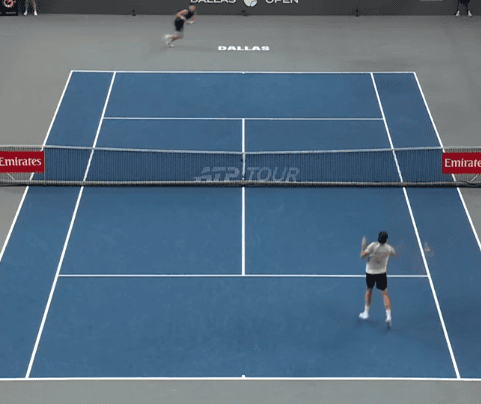
Shelton read it and was there in plenty of time to hit a speedy crosscourt passing shot. Shelton ended up breaking, with Fritz ending a poor game with a backhand into the net off a trading ball from Shelton.
At 1-1, 30-40 (4:52), it looked like Fritz might have wrong-footed Shelton and got ahead in the rally after several shots. But rather than looking to reset the rally with a safe, loopy shot crosscourt, Shelton stopped, open-stance, and fired a winner down the line.
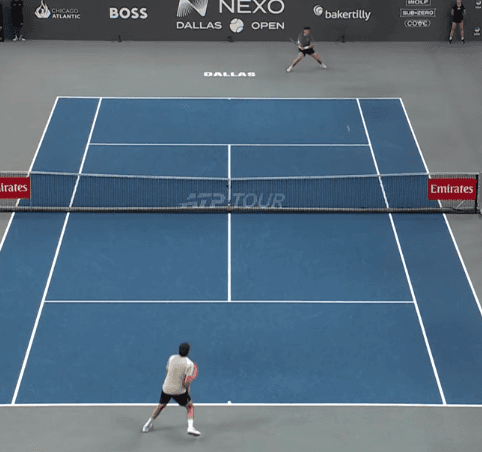
A roar wasn’t enough this time. He spun around and let a cry out for about as long as his lungs could last.
Fritz showed another side to his game when he chased down a drop shot that looked destined to be a winner, with Shelton serving at 3-2 in the third. It was the game where he broke back, and borrowed a leaf from de Minaur’s book to do it: make the next shot. Make him play, again and again.
In the next game, Shelton showed his own speed in what might have been the point of the tournament (5:39). He had to sprint to reach a net-court, and then reacted expertly to a shot fired straight toward his chest.
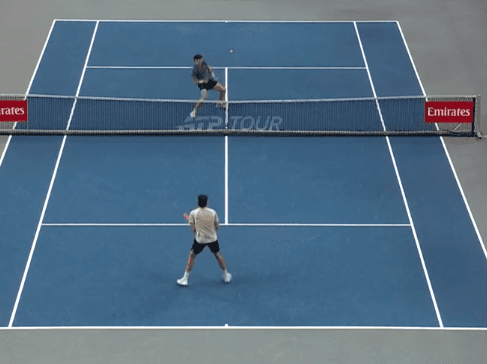
But the very next point, Shelton missed a relatively easy return - the type of shot you’d be shocked to see de Minaur miss.
When serving to stay in the match at 4-5, 15-30, Shelton made a particularly loose error on a central forehand to give Fritz two match points. Shelton saved them both, the second with a beautiful wrong-footing inside-out backhand. But the next point, he went for too much and missed a forehand into the net. 40-40 in potentially the last game of the match: the sort of time de Minaur would play the percentages even more. But again he saved a match point, and again by attacking.
Perhaps that speaks to something fundamental, something that Shelton won’t - can’t, even - change. He wants to attack, so-called “percentages” be dammed. He won the game, the last point the best of the lot (6:43).
After a straight sets victory in the first round, Shelton’s next four matches all went the distance. Shelton would have got to bed late after his 4-6, 6-4, 7-6(4) semi-final win over Denis Sapovalov and the following media duties. He did not look his freshest on Sunday, but still battled through. (With the venue’s apocolyptic grey design and LEDs he might not have been the only one without a strong sense of time.) In the final, after roaring, screaming “Vamos!” and saving three match points, Shelton finally let the wear and tear show, kneeling on the court after winning. His first indoor title was in the bag.
De Minaur has significantly improved his serve over the last few years and in the Rotterdam final against Felix Auger-Aliassime did not face a single break point. 78 minutes after beginning his third successive Rotterdam final, after losing the last two, he too won a first indoor title.
In the Rotterdam semi-final against Ugo Humbert, the score was 6-4, 5-3 until de Minaur finally hit a groundstroke winner. They’d played 120 points. For the vast majority of the match, he hasn’t done anything particularly highlights-worthy. De Minaur had simply been consistent. He’d played the percentages over and over. Put the ball in the court. Sky Sports commentator Barry Cowan said, “At no stage do you feel he’s going to miss” and that young players could learn from de Minaur “doing the basics exceptionally well”. That in itself is special. It’s easy to downplay consistency.
When Hubert was serving at 3-5, 40-40 in the second set—the most important point of the match so far—he attacked. He was the one to change direction and spins, the one to take risks. And de Minaur did what he can do all day: hit the ball back where it came from.
Top image from TennisTV.