


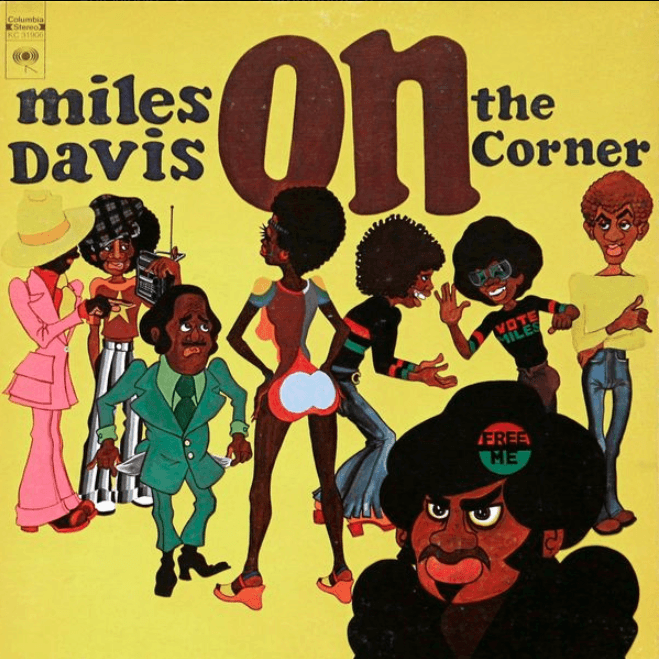
Before Herbie Hancock missed a couple of gigs and got the sack from Miles Davis, who didn’t believe Hancock had food poisoning, he had played on Miles’s seminal albums Live-Evil (1972) and On the Corner (1972).
The albums contained extensive editing by producer Teo Maceo, overdubs, electric instruments (what!), synths – all the things that made jazz purists sick. By the time of On the Corner, Miles had been influenced by electronic pioneer Karlheinz Stockhausen’s tape editing techniques. (Similarly, Hancock got his Mwandishi band to listen to Stockhausen while on tour.)
Miles wrote in his autobiography:
“I had always written in a circular way and through Stockhausen I could see that I didn't want to ever play again from eight bars to eight bars, because I never end songs: they just keep going on.”
Davis had, rather bafflingly, envisaged On the Corner connecting with the youth and allowing him mainstream success. It’s fascinating music, but try dancing to On the Corner for more than a few bars.
‘On the Corner / New York Girl / Thinkin' of One Thing and Doin' Another / Vote for Miles’ by Miles Davis
Hancock’s Mwandishi period could be similarly hard work. He wrote in his own autobiography:
“There were times we shared so much empathy and connection onstage that it really did feel spiritual. But when Mwandishi was off — when we didn’t connect — the experience wasn’t pleasant, and what we were playing just sounded like noise, even to us.”
‘Sleeping Giant’ by Herbie Hancock
Listen to the percussionless section of ‘Sleeping Giant’, the opening track of Crossings (1972), from 17 minutes.
For Head Hunters (1973), Herbie kept Miles’s extensive track lengths, the electronic instruments, and the freedom to overdub, but brought the playing back down to earth. You can dance to ‘Chameleon’. It’s difficult to not at least tap your foot to ‘Watermelon Man’.
Sly Stone wrote in his memoir:
“Miles had been turned around by the kind of music we were making, and the musicians who went in the same direction as him used us as a compass also. Herbie Hancock named a song for me on his Headhunters album that year.”
Not all of Head Hunters was carefree jazz-funk. There’s quite plain differences in something like ‘Sly’ with the music Sly actually made.
‘Sly’ by Herbie Hancock
At the time, critics saw Head Hunters as Hancock selling out, but it’s hardly easy listening. Check out the (sometimes dissonant) cries of saxophone between 2:35 and 5:18.
But ‘Watermelon Man’ and ‘Chameleon’ became jazz-funk standards, and paved the way for jazz that leant heavily on groove, like Grover Washington, Jr.’s Mister Magic (1975).
‘Mister Magic’ by Grover Washington, Jr.
The title track is anchored by a punchy bassline from Gary King. Drummer Harvey Mason, who played on Herbie’s Head Hunters, keeps time with his ride cymbal in a long series of tasteful fills and rolls. After the track’s nine minutes, you could keep listening to Mason’s kick joining King’s bass on the One for another nine minutes.
More recently, bandleader-drummer Yussef Dayes has melded jazz and funk (and a myriad of other genres). Yussef Dayes called his 2023 debut solo album Black Classical Music partly because he wanted his music to be timeless. Dayes drew inspiration from writings by Miles Davis and Rahsaan Roland Kirk, who “were just not sure about the word ‘jazz’”.
‘Chasing the Drum’ by Yussef Dayes
‘Chasing the Drum’ combines Alexander Bourt’s skippy percussion (mixed to the left), Charlie Stacey’s sci-fi-esque keys, heavily syncopated drumming from Dayes, and mournful saxophone from Venna, whose distinct tone gives the album much of its character. Bassist Rocco Palladino hitting the One means the track is funky even when it’s wandering, purposeful even when there’s no clear path. There’s no real head-solo-head structure. There’s arguably no lead instrument: at times Palladino’s bass takes centre stage; at others Venna’s sax dominates.
Hancock kept the funk going in the years following Head Hunters (listen to the synthesizer and bass taking turns riffing on ‘Palm Grease’, or the scratchy guitar of ‘Hang Up Your Hang Ups’), before playing his part in the electro-funk innovations of the 1980s. We’ll explore those sounds later in this series.
Top image from Discogs.