


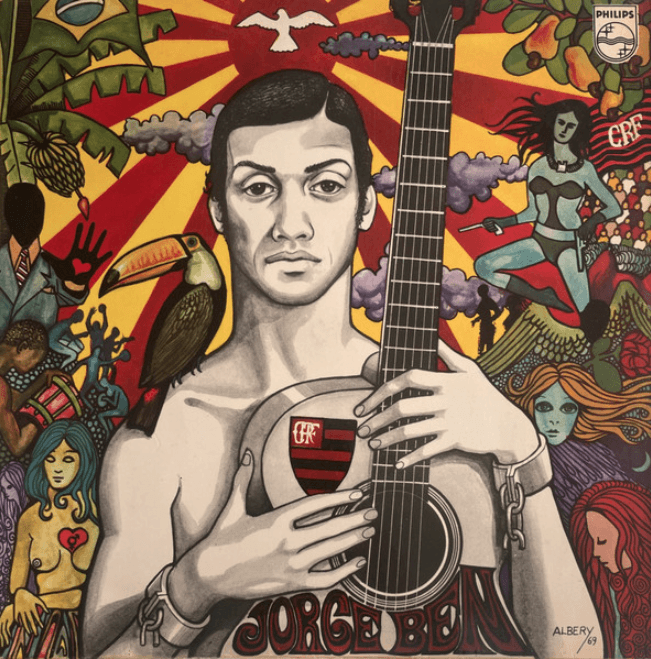
January is Jorge Ben Month on Edge of the Line. In the coming weeks we’ll celebrate the 50th anniversary of his album África Brasil with four editions of Friday Funk. In the meantime, let’s dig 5 of his best songs from before that momentous blend of samba, rock, soul, and funk.
At the time of these records, Jorge Ben Jor was simply Jorge Ben. He changed his name to Jorge Benjor, reportedly after being told by his numerologist that it was a luckier combination of letters. He later separated the “Benjor” due to payments being misdirected to George Benson.
‘Mas, Que Nada!’
One of Jorge Ben’s most famous songs, ‘Mas, Que Nada!’, was written by Ben but first recorded by fellow Brazilian musician Zé Maria. Ben’s version arrived on his debut album in 1963. Samba Esquema Novo translates to “New Style Samba”. Ben was accompanied by Meirelles e Os Copa 5, a 5-piece band comprising a flutist/saxophonist, bassist, pianist, drummer, and trumpeter. Ben sings and plays the classical – or Spanish – guitar, or the violão. It’s Pedro Paulo’s trumpet which introduces the main melody. That melody is from ‘Nanã Imborô’, a 1958 song by Meicio Askanasy, José Prates, and Ivan de Paula.
‘Take It Easy My Brother Charles’
The self-titled Jorge Ben (1969) featured a fuller sound than many of his earlier work. Most of the arrangements were by José Briamonte, who was particularly prolific from 1969 to 1980. The lyrics may refer to a rebellious sailor who escaped imprisonment during Brazil’s dictatorship. Jorge is accompanied on vocals by Trio Mocotó. The song features football referee-like whistles: Jorge is a big Flamengo fan and the club’s crest is seen on his guitar on the album sleeve. In the outro, the whistles, guitar, and bass form polyrhythms, grounded by the now-familiar “Take it easy my brother, Charles” chorus.
‘Mulher Brasileira’
Trio Mocotó were credited alongside Jorge Ben on the 1970 album Fôrça Bruta, translating as “Brute Force”. The album was recorded in one night and important in the development of samba rock. Drummer Jõao Parahyba said the intention was to create a groove that matched Jorge’s guitar and leant more towards rock. Fritz Escovão plays the cuíca, a Brazilian fiction drum that would feature prominently on Africa Brasil.
The tranquil strings, their sustained notes contrasting with the cuíca’s fidgeting, are reflective of the album’s mood. The “Brute Force” title has been interpreted ironically, given the relaxed atmosphere, but may refer to the dictatorship. Jorge was becoming more political, but was never imprisoned, unlike contemporaries. ‘Mulher Brasileira’ seeks to empower Brazilian women, regardless of their appearance—“Preta, branca, pobre ou rica / Bonita ou feia, você é maravilhosa” or “Black, white, poor or rich / Beautiful or ugly, you are marvellous”—and is one of many examples of Jorge championing his fellow Brazilians.
‘Quem Mandou (Pé na Estrada)’
One of Jorge’s contemporaries who was imprisoned was Gilberto Gil, because somebody thought he had parodied the national anthem. Ben and Gil recorded an album together and titled it simply Gil e Jorge (1975). The album features much improvisation and a 14-and-a-half-minute jam on Jorge’s famous song ‘Taj Mahal’. The album is rhythm heavy; ‘Quem Mandou (Pé na Estrada)’, another Ben tune, hardly needs percussion. The pair’s guitars are relentless, playing slightly varying rhythms and unpredictable higher-pitched chords and upstrokes. There’s a lovely few moments when they come together from 2:10; it’s brief and fleeting. It sounds like there’s just too much energy in the room to be contained to one rhythm. Djalma Corrêa’s mouth-pop-like percussion and Wagner Dias’s bass add to the fun, as though anyone’s foot wouldn’t already be tapping.
‘Eu Vou Torcer’
Jorge Ben Jor’s ‘Eu Voi Torcer’ opens with the sprightly strummed guitar that supplies most of the song’s rhythm. While his A Tabua De Esmeralda (1974) album explored themes of race, mysticism, and alchemy, ‘Eu Vou Torcer’ at first appears to have relatively simple lyrics concerning peace, love, and pretty girls. But Jorge shouts out Saint Thomas Aquinas, who is credited with “embedding Aristotelian philosophy into the Christian faith, thus attempting to amalgamate reason and religion” (per BBC Brasil). Jorge learned Latin because of the saint’s “beautiful texts”, and has namechecked Suma Teológica which concerns humanity’s existence and relationship with God.
But you needn’t know any of that to appreciate the song. As across much of Ben’s discography, his guitar and voice combination is so beautiful it makes you slow down even when he’s strumming fast. In the final chorus, Jorge strains his voice at the top of his range as he sings “Pela alegria, pelo amor” (“For peace, for love”).
Top image from Discogs.