


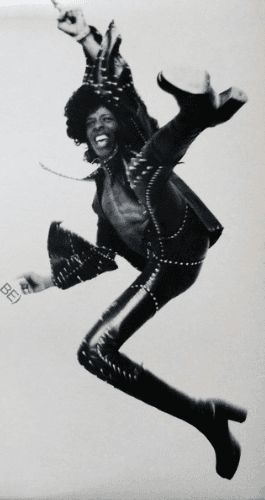
This month is Sly September here on Edge of the Line, in honour of 2026 marking 60 years since the formation of Sly and the Family Stone.
In 1965, James Brown birthed funk with ‘Papa’s Got a Brand New Bag’. Some argue that funk’s true birth came in ’67 with ‘Cold Sweat’. Either way, Brown diverted the path of popular music across the world.
Before then, melody (a sequence of notes) and harmony (two or more notes played together) were treated as gospel; a song was not a song unless those two elements were the focus.
In late ’69, James Brown recorded ‘Funky Drummer’, taking his emphasis of rhythm further. Now the drummer, Clyde Stubblefield, was the star. It’s fair to say it is Stubblefield’s track as much as it is Brown’s.
‘Funky Drummer’ is a song – for the definition of a song is merely music and words. Brown didn’t sing on it much. What does he do exactly? He doesn’t ‘rap’ as we understand that word today; Brown barks, or hollers: “Cut off the lights and call the law!”; he commands the band: “When I count to four, I want everybody to lay out”; and, excited by Stubblefield’s break, Brown gives the track a title mid-recording: “The name of this tune is ‘The Funky Drummer’.”
In other words, the star of the song is the drummer.
Released a few months after its recording, ‘Funky Drummer’ stood apart from other 1970 Billboard hits like Simon & Garfunkel’s ‘Bridge Over Troubled Water’ and The Carpenters’ ‘(They Long to Be) Close to You’. It didn’t reach those heights, but ‘Funky Drummer’ did peak at #51 on the Hot 100, and #20 on the R&B charts.
More importantly, it helped shift the perception of what a song could be – and in the following decades, provided thousands of artists with funky samples. An extended version of the track (soon heavily sampled) was released on In the Jungle Groove (1986), which compiled some of Brown’s rhythm-focused songs.
Sly’s rhythm
Sly and the Family Stone were among the bands to follow in Brown’s footsteps. Some critics argue they took it further. Often they’re credited for blending other genres (soul, psychedelic soul, rock) with funk; those other styles include more melody and harmony. Is that “better”, or different?
By 1970, Sly was emphasising rhythm over melody and recording There's a Riot Goin' On (1971). Even songs like ‘Family Affair’, which had catchy melodies and hummable chord changes, were influential for their use of rhythm.
Sometimes Sly’s rhythms weren’t his own. ‘Family Affair’ was among the first pop hits to feature a drum machine, and the bulk of the track is “preset rhythms” from the Maestro King. As Sly wrote in his memoir, “most of the Family Stone was nowhere to be found.” There’s Bobby Womack on guitar, Billy Preston on Pianet, and Sly. He described partying and drinking before heading upstairs to his studio; his voice was “so hoarse [he] had to ride in on it.” There’s a wonderful chorus vocal from “One-Take Rose”, Sly’s nickname for his sister Rose Stone.
For other songs made with a drum machine, Sly would flip the rhythm around – rather than having the Rhythm King start on the One, Sly started “on two, or maybe on three, which inverted the rhythm”, recalled Family Stone drummer Greg Errico. That way, the early drum machine sounded less like “something you would use if you were a lounge act in the Holiday Inn”.
Many other times, Sly’s rhythms were very much his own. The ballad (or funk ballad), ‘If You Want Me To Stay’ on the following album Fresh (1973) has beautiful, unpredictable harmony (the non-diatonic progression of Bm, Am7, D9, G7, F#7) and melodies that would carry a song without much rhythm. But Sly inserts rhythmic emphasis to make the song even more intriguing.
Sometimes his vocal rhythms are based on the main bassline (“You can take me for granted”, 0:49; “When you SEE me again”, 2:09); elsewhere he’s hitting offbeats it’s hard to imagine any other singer choosing (“Oh-oh-oh”, 1:22; “I wish I could-AH!”, 1:44).
Performing the song live, Sly would lean into the rhythmic elements even harder.
Brown’s 1970s groove-based songs like ‘My Thang’ and ‘People Get Up and Drive Your Funky Soul’ generally settled on a minimal chord progression, and it was the polyrhythms and changes of emphasis that provided a sense of momentum.
But Sly mixed it up: one song might have a complex chord progression; the next might be based on a one-chord vamp.
‘In Time’, the subject of a recent Friday Funk, is like two songs in one: although the tempo remains the same, the verses and choruses seem to be at different speeds. On top of that, in the verses we’re constantly pushed and pulled by Sly’s vocal emphasis and the different instruments playing wildly contrasting rhythms.
In ‘In Time’, Sly works against conventional theory. Rice University’s Anthony Brandt and Robert McClure wrote,
“Harmonic rhythm is the speed at which the harmony changes.”
The authors explained,
“The pacing of harmonic rhythm is a key component of our subjective sense of time passing: When the harmonic rhythm is slow, time feels suspended”.
The intro and chorus of ‘In Time’ have far more chord changes than the harmonically simple verse. Yet it’s the verses that seem to be rushing. The web of polyrhythms – too much going on for our brains to consciously assess at once – takes over from harmony.
Then the chorus seems to slow us down. That’s despite the beat not slowing, and there being more chord changes.
What’s so special about melody anyway?
Western musicians, critics, and fans often treat melody and harmony as superior to rhythm. Those taught that a “good” song or piece of music should emphasise those elements still struggle with the idea that rhythm is king.
Brown’s emphasis of rhythm and the One, and artists like Sly using drum machines, have had as much impact on music as any musical innovation by The Beatles. But what are you more likely to hear: that Brown’s a genius, or that Paul McCartney’s a genius?
There’s still resistance, after more than 60 years since Brown’s innovation and 30-plus years since rap started taking over the charts.
This has been the case since before the birth of jazz, decades before its rhythm-heavy cousin funk came along.
Why?
The Grove Dictionary of Music and Musicians (Oxford University Press) identifies the cultural biases in written theory:
“In Western culture the musics that are most dependent on improvisation, such as jazz, have traditionally been regarded as inferior to art music, in which pre-composition is considered paramount. The conception of musics that live in oral traditions as something composed with the use of improvisatory techniques separates them from the higher-standing works that use notation.”
There’s another related, simpler answer: most music critics are white, most people in power are white, Brown and Sly were not, and many people are racist.
Lumen Learning, in an article theoretically written for “Music Appreciation”, argues:
“Harmony is one of the basic elements of music, but it is not as basic as some other elements, such as rhythm and melody. You can have music that is just rhythms, with no pitches at all. You can also have music that is just a single melody, or just a melody with rhythm accompaniment.”
Part of that is true. You can have music that is just rhythms. Does that make it more “basic” than harmony, in all contexts? Try telling a classical pianist to drum like Stubblefield.
And another reason why rhythm is underappreciated: religion.
Churches traditionally de-emphasised rhythm. As Worship Leader says, “When rhythm dominates, singing often decreases.”
And churches want devotees singing – they want “healthy worship”. Melody must lead, and harmony must support. Rhythm is allowed to be “energizing”, but it mustn’t be “too dominant”. God forbid.
In contrast, Ministry (the International Journal For Pastors) was more complimentary about the power of rhythm. It said in 1974:
“...all nature is rhythm, whether it be the heartbeat or the ebb and flow of the waves on the shore.
If the definition of rhythm is complex or obscure, certainly the physical and psychological effects are unmistakable. Recent developments in the field of musical therapy have shown us the definite physical and emotional effects of rhythm even to measurable changes in body metabolism, respiration, and blood pressure. The tremendous effectiveness of work songs and marching songs in reducing fatigue and inducing coordination is a well-accepted fact. It has also been established that a slow tempo with long notes gives the impression of nobility, dignity, and peace, while a rapid tempo with short notes gives the impression of excitement and restlessness.”
Rhythm, just like harmony, can be complex:
“...only after intense study can one begin to hear (much less to reproduce) the intricacy and complexity of [African tribal] rhythmic patterns. Intriguing as this is as an art form to the musician, it must be admitted that these very rhythms repeated incessantly are frequently used in primitive societies to produce the well-nigh hypnotic states so vital a part of pagan rites and orgies.”
Of course a journal for pastors decried orgies, however “intriguing” the rhythmic complexity that apparently inspired them might have been.
Top image from Discogs.