


We conclude our six-week celebration of 60 years of funk with an unsung gem from the Horny Horns.
Inspired by Motown’s array of stars, George Clinton started to expand the Parliament-Funkadelic universe in the mid-1970s. He wrote in his memoir,
“Fred [Wesley] and Maceo [Parker] wanted their own project, and they had helped us plenty, so we helped them. (...) With all the players around me, all either finding their voice or finding ways to use the voice they already knew they had, P-Funk was painting with all the colors and then some, on a canvas that was getting bigger and bigger.”
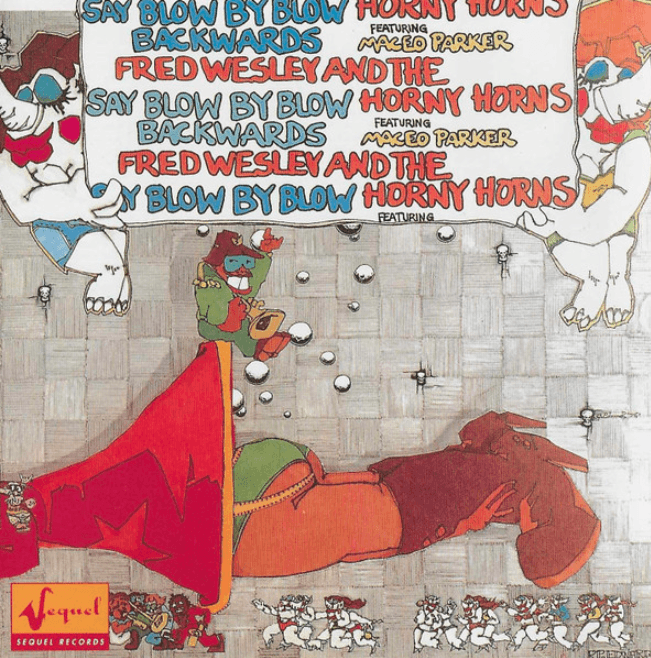
The first two albums by Fred Wesley and the Horny Horns were credited as “Featuring Maceo Parker”. The saxman could easily have had equal billing: he’s the star on many of the tracks and shares arranging duties with Wesley. There was a third album of previously unreleased tracks, from the same sessions, released way later in 1994. Maceo wasn’t credited as a featuring artist there, but his first name appeared on the record sleeve.
“Fred”, “Maceo”, “Kush”, “Rick”: these four players were the Horny Horns. Wesley, Parker, Richard “Kush” Griffith, and Rick Gardener were largely responsible for the peak of P-Funk hornery – songs like Parliament’s ‘Mothership Connection (Star Child)’, ‘Getten’ To Know You’, and ‘Funkin’ For Fun’.
Many of the other instruments on Horny Horns records were played by Bootsy’s Rubber Band, the main spinoff from the P-Funk universe (Bootsy’s popularity at one point ascended Parliament-Funkadelic’s). It was only fair – the Horny Horns played on Bootsy’s albums.
Parker often sang. On ‘Half A Man’, a standout from the second record, Say Blow by Blow Backwards (1979), Parker’s joined on vocals by Robert Peanut Johnson, Gary “Mudbone” Cooper, and Jessica Cleaves (per the excellent The Authorized P-Funk Song Reference, 2024).
Billy “Bass” Nelson, an original Funkadelic member, did not have many writing credits, but this song was a co-write between him and Clinton. He did co-write some classics, including Funkadelic’s ‘Music for My Mother’, ‘I Wanna Know If It’s Good to You?’, ‘Hit It and Quit It’, and ‘Super Stupid’, as well as Parliament’s ‘I Call My Baby Pussycat’ and ‘Placebo Syndrome’.
Right from the start, Nelson’s bass is prominent. A mix of staccato notes and more sustained, repetitive notes lead up to the One. After one minute, Nelson’s bass joins the lead guitar, playing almost the same part in unison during the bridge section (the first of which is wordless, then has the “Such a pity” lines). The horns play a great ascending part with notes on each beat before a blast on the One.
The horns are brilliantly recorded and mixed so that their punchiness resembles a live concert. Other than in the bridges, they leave the One to the drums and bass. In the verses, they dovetail with the lead vocal, providing much of the momentum through the nine minutes.
The “I’d be half a man if I didn’t do all I can” is the kind of wordplay Clinton was, and still is, full of. Although others’ voices were developing around him, Clinton’s influence was felt on an array of projects by the Horny Horns, Rubber Band, and Brides of Funkenstein.
The lead guitar (mixed to the left) is unusually bluesy for P-Funk. Not since Funkadelic’s debut in 1970, with songs like ‘Music For My Mother’, had they worn that influence so clearly. Maceo’s rasp contrasts nicely with Cleaves’ softer delivery, particularly when they go back and forth with the “Such a pity” line.
The stars, though, are the horns. As Maceo has said, this was when the horns took control.
Top image from Discogs.