


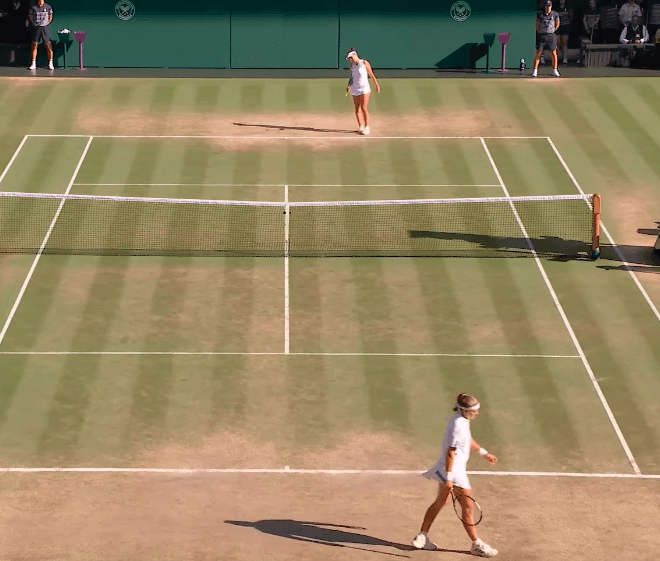
In the women’s singles final at Wimbledon last week, Linda Noskova almost let her emotions take over. The 21-year-old had played an excellent first set and was up 6-2, 5-2 when the reality of having match points for her first Grand Slam title became too much. Noskova double-faulted on championship point and held off seven break points, before letting the second set lead – and five championship points – escape her. Karolina Muchova fought back, winning five games in a row to take the second set 7-5.
Noskova did what many great players have done before to turn a match back around: have a bathroom break. She held serve at the start of the deciding set and reasserted her authority, mixing powerful serves and topspin shots with delightful slices and drop shots.
Jeff Greenwald, M.A., MFT, a sport psychology consultant, wrote in The Best Tennis of Your Life that players should avoid letting their emotions “running the show”. Greenwald advised that many people feel their emotions are “simply part of their make-up”. Emotional reasoning is common: we let our emotions dictate how we feel about ourselves.
But if we have a thought such as, “I’m not playing well today”, or, “I’m a terrible tennis player”, that thought can pass. We don’t have to “become entrenched in negative emotions”, as Greenwald puts it. If we pay attention to our thoughts, and let them go, we can get onto a more positive track.
Novak Djokovic, 24-time Grand Slam winner, has said,
“No one on this planet—no monk, no priest—lives without negative thoughts. The difference is how long you stay in them.”
Djokovic’s mentality is often considered the greatest in the sport’s history. Throughout any of the two dozen Slam finals he won, he might have roared at the crowd, he might have shouted at his box, but he very rarely let his emotions derail the match. He let them out, and moved on.
Greenwald advises tennis players to ask themselves, “What am I thinking right now?” when they’re feeling angry, impatient, panicky or low on confidence; then to ask themselves if what they’re thinking is really true, and whether there’s another perspective.
That’s a different approach to that of meditation in Buddhism and other traditions, in which practitioners notice thoughts and watch them impassionately. They don’t judge a thought; they recognise it’s there and let it go, returning to their focus: breath, sound, or the feeling of their footsteps, for example.
But the objectives are different: in meditation, the goal is to become more aware, more present. In tennis, the goal is often to be positive and remain in a mental state to keep fighting and believe you can win.
Djokovic, a mindfulness practitioner himself, wrote in his 2013 book Serve To Win that he practiced “about fifteen minutes” each day, and it was as important as his physical training. More recently, the Serb has said, “Sometimes it varies – meditating, conscious breathing exercises, hot and cold sessions like ice baths.”
Noskova said that it’s never easy to win a match point, and that every match at Wimbledon had been “so tough physically and mentally”. Former pro and BBC pundit Eugenie Bouchard praised Noskova’s resilience to come back from the disappointing second set collapse. If she is to get anywhere near Djokovic’s Slam record, Noskova will have to overcome similar obstacles nine months every year for decades.
In the third round, Noskova had come back from a 2-6 first set deficit to beat Sorana Cirstea. She had lost three of four previous meetings with the No. 17. Noskova said after the win,
“I just refused to lose the match. I was telling myself that it's never over, obviously, that the last point always decides.”
Top image from ESPN / Wimbledon.