


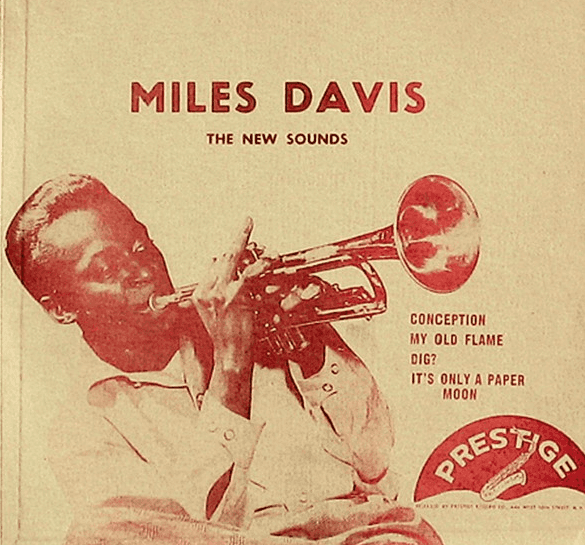
October is Miles Month here on Edge of the Line. We’re celebrating 75 years since the recording of Miles Davis’ The New Sounds (October 1951). 2026 also marks 100 years since Davis’ birth (May 26, 1926).
In 1951, Miles Davis recorded and released his debut solo album, The New Sounds. He’d previously played on singles, including as a sideman, but new technology gave him a chance to stretch out – including on ‘Dig’.
Biographer Richard Williams wrote in the acclaimed Miles Davis: The Man in the Green Shirt:
“Davis was told that the session would be released on an LP, and that he no longer needed to worry about making every piece conform to the three-minute limit of the old 78 rpm disc. This was effectively the moment at which he began his challenge to conventional ideas of the musical time-frame – a challenge which was to become the major preoccupation of popular music towards the end of the century, and one that would eventually link him with such contrasting creative forces as James Brown and Andy Warhol.”
The album was Miles’ first experience as a bandleader. He said of his music on the Prestige label, “The records that I made helped me later in becoming a good bandleader, helped me understand how records—good records—are made.”
Prestige credited one of the four compositions – ‘Dig’ – to Miles, but its chord progression has been called “almost identical” to that of ‘Sweet Georgia Brown’ by Ben Bernie and Maceo Pinkard (lyrics by Kenneth Casey). Miles makes slight changes like tweaking an Ab chord to an Ab6.
Bernie and Pinkard’s tune was written in 1925 and had become a jazz standard. Other jazz giants like Cab Calloway, Art Tatum, and Charlie Parker and Dizzie Gillespie (together) had all recorded their versions.
The second time Miles recorded ‘Dig’ (titled ‘Donna’ this time), it was credited to Jackie McClean, said to be the original composer of the melody in ‘Dig’.
McClean was in Miles’s band for The New Sounds, playing alto saxophone.
Sonny Rollins was on tenor sax, and among those who went on to record their own versions of ‘Dig’, which itself became a jazz standard.
Art Blakey is on drums but it’s far from his most headscratching, seemingly-six-limbed performance. Although the speed of Blakey’s snare and cymbals increases in the second half.
Tommy Potter plays double bass. This was before recording technology, and opinions on what a bass player ‘should’ do, allowed bass tones to feature more prominently in jazz and later star in jazz-funk.
It was also before Ron Carter joined Miles’ band for the Second Great Quintet in 1963. Jazz tunes in the ‘50s generally had the bass following the chord progressions, contributing minimally to melody, and serving as a background instrument.
Carter told Track Star that in tunes like ‘Round Midnight’ (1955),
“I think what we’re talking about here is that there’s still no presence of the bass. (...) Miles is the headliner, and Monk is the headliner, and whoever’s playing drums is the headliner in that broad sense of ‘headliners’. The bass player’s still kind of fighting its way through the palm trees.”
Contrafacts
The practice of taking an existing song, often a standard (‘Sweet Georgia Brown’ in this case), and giving it a new melody and arrangement results in what’s called a contrafact.
Jazz is full of them.
The progressions in songs like ‘I Got Rhythm’ (George Gershwin) were lifted by various jazz heavy-hitters: Nat King Cole (‘Bop Kick’), Art Pepper (‘Brown Gold’), Clifford Brown (‘Brownie Speaks)’, and Bud Powell (‘Bud’s Bubble’).
Charlie Parker took Sigmund Romberg’s ‘Lover, Come Back to Me’ for his ‘Bird Gets the Worm’; J. J. Johnson liked Illinois Jacquet’s ‘Robbins’ Nest’ for his ‘Boneology’; Horace Silver’s ‘Split Kick’ was based on ‘There Will Never Be Another You’ by Harry Warren.
And so on.
Miles’ one-time bandmate Thelonious Monk used the same tune (‘Sweet Georgia Brown’) as inspiration for his ‘Bright Mississippi’.
Miles’ sound
Miles’ phrases in ‘Dig’ are mostly long and wandering, often ending on an uplifting high-pitched note, during his solo (after the sax solos). Then he’s more concise during the final section.
His most significant arrangement choice might be having himself and Rollins play in unison during that final section (from 7:00). This led to perhaps the most beautiful moments of the track, including the joyful runs of notes from 7:03 and 7:25.
The official Miles Davis site says the trumpeter later wrote, “I like what I played on ‘Dig’, because my sound was really becoming my own thing”.
Top image from Discogs.